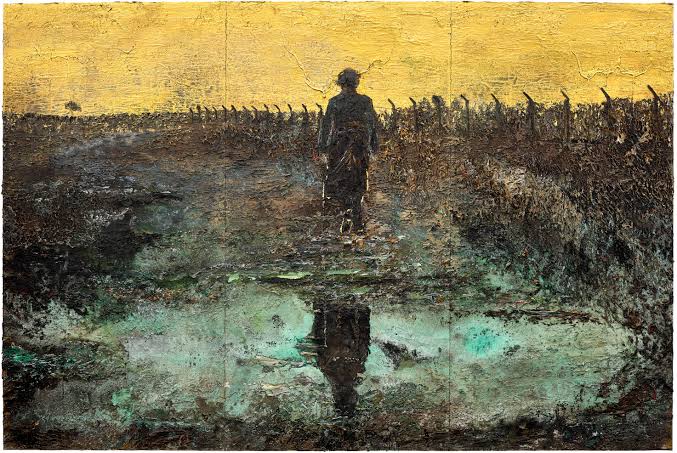
(better to watch it on YT for hi-res)
Hands Off
My new dog is called Roek. I did not plan on getting her. But Mahru, my old dog, had always lived in a pack, until circumstances changed and the pack broke apart. Mahru was left alone without her pack. I can not explain to her why her little brother and sister were taken away from her.
It took many walks in the woods with Mahru before I made the decision. Quiet walks, without agenda, I am bad at planning anyway. It was just the two of us moving between the trees, thinking things over, switching from rumination to wandering back to rumination again.
I lost the ability for deep contemplation in the previous years, like many of us have in the age of neoliberalism. Maybe that’s why I resist turning everything into some carefully thought out structure or instruction now. With Mahru, and now with Roek, we are just being together. Farting around, really, in the sense Kurt Vonnegut meant it.
Roek knows only a few commands, and I don’t plan to teach her many. Like Mahru, she’ll figure it out.
We move through the dense forest, the three of us, the canopy closing above us, light arriving in fragments. No destination. No plan. No corrections. No rewards.
Listening to the dawn chorus, I think that this is the only way a person can have an honest relationship with your dog.
How people train dogs is not just a practical question, I don’t think. It reflects something deeper. It shows how we see them or maybe, whether we see them at all as living individual beings with a soul.
Byung-Chul Han on Dog Training
In The Burnout Society, German Korean philosopher Byung-Chul Han identifies a fundamental shift in the architecture of power over the last decades. The disciplinary society described by Foucault was organised around prohibition and surveillance. It was about the suppression of deviant behaviour. But this society has given way to what Han calls the achievement society of neoliberalism.
The disciplinary subject used to be defined by what it was not allowed to do and what it should do. Now, the achievement subject is defined by what it can do. We shifted from ‘may not’ to ‘can’ and negativity is now replaced by positivity.
But this is not progress at all. The achievement society does not liberate. The achievement subject suffers under the weight of unlimited possibility, he is driven by the compulsion to perform and to optimise. The burnout that Han diagnoses is not the result of oppression, but of a self-exploitation, we have become both master and slave.
Han is clear:
This society produces its own specific form of mental illness. Our previous, disciplinary society produced madmen and criminals, people who broke the rules, while the moden achievement society produces depressives and losers. Who, like myself, have broken under the weight of endless self-demand and striving. We are optimizing ourselves to death.
The history of dog training followed a similar path, I think.
For most of the twentieth century, dog training was discipline based. It was rooted in dominance theory, the idea that dogs are hierarchical animals who are constantly vying for status.
The tools were therefore correction-based. There were choke chains, prong collars, and shock devices. The handler called himself the alpha. Unwanted behaviour was suppressed through pain and fear. The dog learned what she was not allowed to do.
In the eighties and nineties, I grew up with Great Danes and my parents too, used choke collars and disciplinary methods, as everyone did then.
In the recent decades positive reinforcement training rose to dominance. It presents itself as the humane alternative. There are no punishments. In their place: rewards, clickers, treats, praise. That may look like liberation, but it’s not, it is an illusion.
When you look more closely at what positive reinforcement training produces it becomes obvious. The dog is in a permanent state of performance. It works for rewards and is in constant anticipation of the next command or signal. It is learned helplessness.
What is worse, is that the training session never truly ends, and every interaction becomes an opportunity to reinforce or weaken certain behaviour. And a dog that is always striving,and always dependent on the human for the next cue, that is not a free dog, that is a slave dog. That is Han's achievement subject in animal form.
Both methods look different, but share the same central assumption: the dog is not a subject but a project. Something to be shaped into our understanding of what a good dog looks like, and that is not a good thing. We used to roam the continent together, side by side.
A dog trained by disciplinary methods is a prisoner, while the positive method rewires the dog's desire, she is a slave. Neither asks what the dog actually is.
Speaking of desire. Buddhists believe that this desire is the cause of all suffering, but more on that in another essay.
Martin Buber on Dog Training
Martin Buber was a jewish theologian and philosopher who hasn’t written a word on dog training but he offers a better approach, I think.
In I and Thou, published in 1923, Buber describes two fundamental modes of relation. The I-It relation, is the relation of use and functionality. The other, this can be a person, or an animal, or a tree, is experienced as an object in your world, she is defined by her properties and usefulness to you. The I-Thou relation is something else entirely. It is a relation of genuine encounter. The Thou cannot be measured or managed. She can only be met.
In an autobiographical passage he recalls spending time with a horse on his grandparents' estate:
What he is telling here, I think, is that the moment he became aware of his own hand, his own pleasure, his own self, the encounter collapsed. The horse did not change. Buber did. The Thou cannot survive self-consciousness. It requires a presence so complete that the self steps back, and what remains is pure relation.
He continues:
Both dominant training methods fail the dog as a person. Both the correction trainer and the positive trainer see only behaviour. Neither is actually present to the dog in front of them. They are always, in Buber's sense, aware of their hand. They are both managing an It. One through fear, one through desire.
I will go further than Buber, who was uncertain whether a full I-Thou encounter with animals was truly possible. Dogs are not people, but they are persons. They have interiority, perspective, memory, grief, joy, and loyalty. Mahru grieved the loss of her pack, she still does. Roek arrived into a world already shaped by that loss. These are not behavioural outputs. They are experiences. And a being that experiences is a being with a soul that can be met or failed.
An I-Thou orientation begins with deep contemplative attention. It requires the human to be changed by the encounter, not only the dog. Both existing methods place the entire burden of transformation on the animal. To approach a dog as a Thou places it on the human.
We are back in the forest now, the three of us. Roek moves through the undergrowth. She is following something I cannot smell and will never understand. Mahru walks beside me, slower than she used to. She has known loss. She has known the sudden absence of her little brother and sister. And she is still here, still walking, still willing to be in relation with a human being after being left. She’s graceful like that.
Roek will learn things too. There will be communication between us, boundaries, shared language built slowly over time. But she will not be a project. I will not break her will or rewire her desire. I will not be aware of my hand.
She does not know she is a Thou. But I do.
Books referenced:
Byung-Chul Han - The Burnout Society (2010)
Martin Buber - I and Thou (1923)
Newsletter
Get essays in your inbox
New essays, no noise. Free, always.