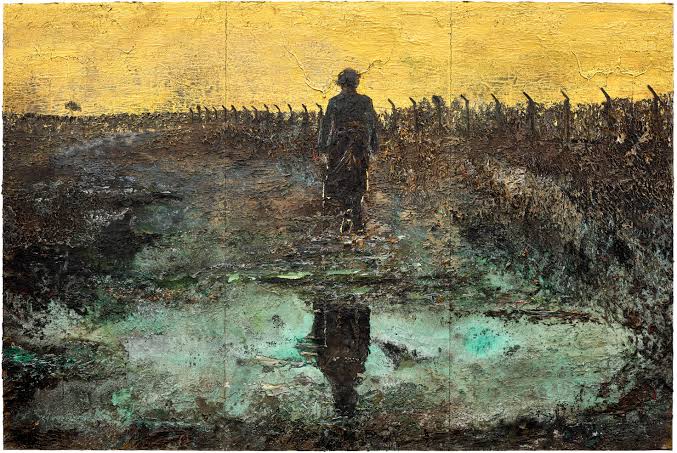
Ye know on earth, and all ye need to know.
— John Keats, "Ode on a Grecian Urn"
I
I met her in the woods a little while ago. Chance. We got talking and found we had all this stuff in common. Oddly specific things, like the gathering of a certain mushroom species. I've never had any patience for small talk anyway. It feels cheap to me, a way of standing next to someone without ever meeting them. This wasn't like that. Today we met up again and hiked.
Before we ever spoke I'd already noticed how she moved. Elegant and purposeful. It made me feel like I was a guest at her place. And even though I practically live in these woods, I felt out of place, like a tourist. Now we walked our woods together. Then out onto the plains, the heather, sun everywhere, warm.
Then I saw her arms. Cuts, and a lot of them. Old ones, sure, but still visible. She wasn't hiding them. I asked, straight out, and she told me straight back. She said she keeps them covered at other places, for other people. Not here. Not with me. And I took that for the compliment it was.
I looked at her arms and thought: she must have been through a lot, and come out the other side quite beautifully.
Most of my scars I wear on the inside. You can't see them. And a long time ago I learned not to talk about them.
With me, she's easy about it, which I'm grateful for. But in many other places, her arms are covered. Not out of shame. She just learned, somewhere (or somewhen), like me, that the world would rather not look. So the real question is not why she hides them, but why the world made her feel she needed to.
II
During our hike, I'm reminded of what Byung-Chul Han, in his book Saving Beauty, calls "the smooth."
The smooth is the signature of our time, he says. It runs through everything now, from the sculptures of Jeff Koons to the screen of a phone to a waxed body. We look at these surfaces and call them beautiful. But Han thinks we have it completely backwards.
What is smooth does not injure, which makes it appealing. It offers no resistance, sure. But nothing catches, and nothing cuts or pushes back, either. A smooth surface asks nothing of you but gives nothing away. It just reflects what you already are. The smooth only wants to be liked. It "deletes its Against," Han says. It strips out anything that could oppose you, or trouble you, or stop you for even a second.
But a thing with no friction is a thing with no character. Character comes from the Greek charassein: to engrave, to scratch, to imprint. A character is a mark burned in. It has duration, solidity and permanence. The smooth carries no such mark. It has been sanded down until there is nothing left to meet. That is why it goes down so easy, and why it has nothing to say.
So the smoothness we call beauty is, for Han, its opposite. Beauty with the resistance taken out is not beautiful at all. It is beauty with the life gone out of it. Pleasant, frictionless, agreeable, and most of all dead.
III
Han describes our current age as the age of 'Like', but 'Like' is not just a preference. We might like this or that. But 'Like' also presumes sameness. To like something (or someone) is to move toward what is already like yourself. Smooth communication, Han writes, "reaches its maximum speed where like reacts to like. The resistance coming from the other disturbs the smooth communication of the same." The 'Like' is not really about what you love. It is about seeking out what is already agreeing with you, reflecting you back, until you never have to meet anything that isn't already you.
During our hike in the sun, she told me about a colleague of hers. The man was delighted he could now pre-heat his car from inside his house. People can't stand a difference in temperature anymore. No experience of the cold or the heat. Everything the same, and awfully dull.
Personally, I love the cold. I love going out into it for hours, sometimes days, questioning my decision with every step. Then, after a long time in the cold, you finally press up against another body, a lover, a friend, for warmth. Comfortably numb. The cold is what makes it mean anything. Take the cold away and you don't get more warmth. You get a heated seat, and probably a heated office room. You get nothing.
I'm reminded of a line from Aldous Huxley. In Brave New World, the perfect world is already built. There is no grief, no pain, no cold. People have everything they want, and don't want what they can't get. They are happy. But one of them, John, refuses this dystopian utopia, in what has become one of the most famous lines in modern literature: "But I don't want comfort. I want God, I want poetry, I want real danger, I want freedom, I want goodness. I want sin." For John, a world without struggle and friction is also a world without love, without beauty, without truth.
IV
According to Han, to really see something you have to be able to be hurt by it. "Sensibility is vulnerability." And: "injury is the moment of truth in seeing. Without injury there is no truth." And not just some-thing, I think, but some-one too. Smooth people can't get under our skin and leave a mark.
Han says the same about love. A society that cannot bear injury avoids it everywhere. What do we do? We keep our options open. We spread ourselves thin across many people so no single loss can cost too much, the way you spread money to limit the damage. It is the smooth heart, the one that risks nothing because it feels from a safe distance. And a heart like that never has to heal, because it can't love.
I'm reminded of Emmanuel Levinas, although I probably don't remember it perfectly. But for the French philosopher, everything begins with the face of another person. Not so much as a sur-face, but the face that looks back and speaks and will not be reduced to something I can fully understand. The Other faces me in all their defenselessness. I cannot turn them into an idea, an image, or a thing to benefit me. It makes me responsible.
This is quite the opposite of the smooth. The smooth wants the same, the Like, the mirror with my own reflection. Levinas' Other shatters that mirror into a million pieces, and that makes us vulnerable.
When I noticed her scars, I became aware at once that it is impossible to fully become part of her history. Of course I could have looked away and kept things smooth, kept my distance. But that would have meant denying her very being. To become aware of another person's pain and struggle opens a small wound of its own, and reminds me of my own. But it also brings a kind of hope, because it shows the pain can be transmuted, that a person can become more beautiful because of it, not in spite of it.
V
It is easy to turn this into a lesson or something. But I'm not an educator and am far from perfect. If I say we should wear our scars with pride, I have only traded one pose for another. Pride and shame are the same move after all. Both still ask the world for a like or dislike.
I know this very well. Most of my own scars don't show. I could stay quiet about them, or I could put them on display and make a spectacle of myself. I would become a performance, a way of seeming deep, of collecting admiration for having suffered.
It is not about pride and shame. Nothing needs to be erased. Not hers, not mine. The scars, inside or out, are only where a life got tough and left marks on our bodies, on our soul. They don't need to be shown, and they don't need to be hidden. They need to be true, and what is true is beautiful.
VI
We walked for hours, longer than I had in years. One small bottle of water between us. And somewhere out there in the sun, I felt something I hadn't in a long time. Safe and vulnerable at the same time.
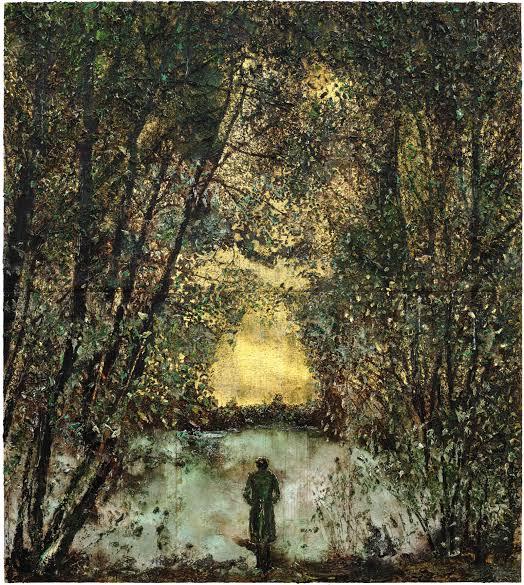
Forget your perfect offering
There is a crack, a crack in everything
That's how the light gets in.
— Leonard Cohen, "Anthem"
Newsletter
Get essays in your inbox
New essays, no noise. Free, always.