I was looking for a video on some old hard drives. I couldn’t find it, but I did stumble on an unnamed PDF file. I opened it and realized it was a long philosophical paper, not the kind of philosophy I enjoy, but the horrible, self-absorbed, pompous post-modern French philosophy I hate more than a colonoscopy with barbed wire.
“Who in their right mind would ever write something this awful?”
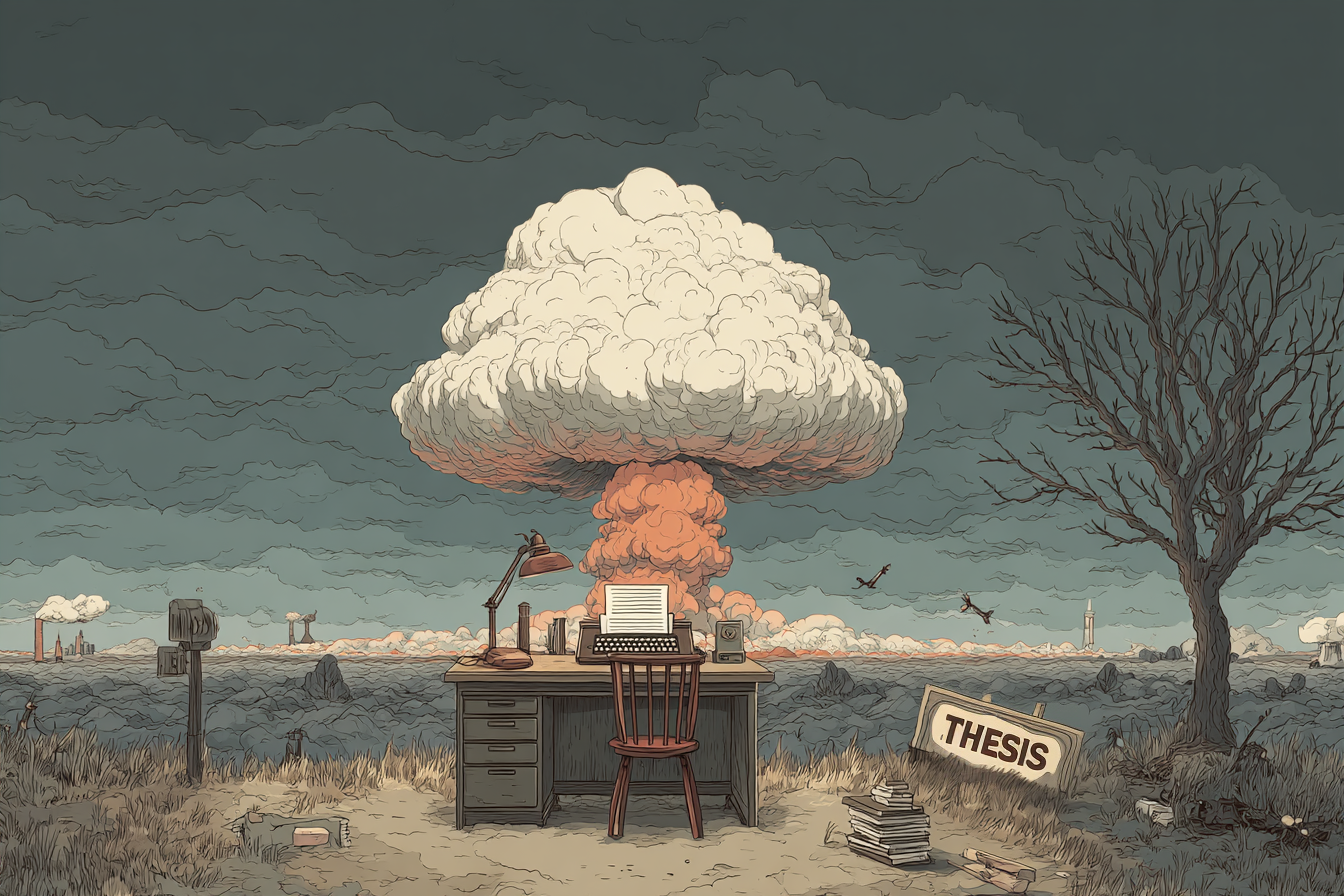
The truth is, I did. I had written something that should never have been written. It was far too long, made no sense, had no structure, and must have been an absolutely horrendous experience for my dissertation advisor to read, for which I am truly sorry.
The worst part is that I was terribly proud of myself when I finished it. I was so convinced of my brilliance that I briefly wondered whether anyone in history had ever received a Nobel Prize for a bachelor’s thesis.
I’m telling this story because that one disastrous thesis made me stop writing for fifteen years, and because I’m slowly learning that the disaster was never the problem. The disaster was in fact the message.
The reality was that I had never written anything longer than a couple of pages. Some papers, some essays, a few articles, but never anything remotely that long. After reading Jean-Paul Sartre and Georges Bataille on authenticity and the limits of human reason, I decided, completely on my own, to write my thesis about the limits of human reason.
Most of the work by clever intellectuals I was reading at the time was difficult, and sometimes completely incomprehensible. This meant that my thesis had to be completely incomprehensible too. This seemed like a good strategy. What could go wrong?
This is my story about how a single creative failure, combined with undiagnosed AuDHD, made me shut up for fifteen years, and how I’m learning that the disaster itself was never the problem. I hope it resonates with artists with autism and autistics with artism alike.
Act I: In the Beginning
Throughout high school and university, I used more or less the same strategy whenever I had to turn something in. Which is, well, no strategy at all. I would think about the assignment for days, sometimes weeks, and then write everything down in one go. For me, planning is some form of profound wizardry, requiring roughly the same level of skill as becoming a neurosurgeon, a fighter pilot, or doing the dishes every month. All of those are far beyond the reach of my raisin brain..
Normally I would have crashed miserably years earlier, but I had a secret weapon. My ex-girlfriend worked very differently. If someone asked her to start a new society on Mars or something, she would have the blueprint ready that same day. Sometimes, when lectures had already started weeks earlier, she’d look at me and ask, “Shouldn’t you be at university?”
I would raise my hands in the air and launch into a rant about how the education system was rigged, deliberately hard, impossible even for me to graduate. In reality I was masking the fact that I was simply terrible at planning. This was almost two decades before I received my autism and ADHD diagnosis.
I’m writing this now because, after a long struggle, I’m starting to learn how to write again. I don’t think this story is unique. If you’ve ever felt physically uncomfortable opening a blank document, this will probably sound all too familiar.
Act II: A Portrait of the Artist as a Young Idiot
For my thesis I had to write at least forty pages. It felt enormously exciting and important. I was sure it would define me in some way. How did people write long-form work anyway? You just put words on paper, I assumed. That was probably how Tolstoy wrote War and Peace. Great work basically writes itself, I thought.
One problem was that I didn’t know I was heading for disaster. I couldn’t type the thing in a single afternoon, that much I knew, so most days I just sat there agonizing over every word, convinced that all great artists suffered, and that my suffering meant I was doing something right.
Another problem was that I was writing my thesis while doing the research at the same time. I also had a tendency to imitate whichever philosopher or art historian I happened to be reading that week. The result was a bumbling mess of styles. I invented new words, wrote familiar ones differently, and introduced subtle nuances that basic language was clearly too crude to express.
It even lacked anything resembling a conclusion. When I felt exhausted, I simply decided it was finished.
To give you an idea of how bad it was, imagine a toddler in charge of the military. He’s seen soldiers in movies, so everyone gets a nice uniform. There are tanks in bold, bright colors. There are spaceships, submarines, exoskeletons, just lots of things that go boom. But beneath the surface there’s no communication, no supply chains, no coordination. The toddler doesn’t understand how the military actually works; he only knows it from pictures.
My thesis was like that. I had no understanding of the invisible systems that make writing function, things like structure, pacing, composition. I didn’t even read it, after finishing it, I printed it out and handed it in.
Act III: The Trial
A few weeks later I was invited to my advisor’s office to review my thesis. The reaction was not what I had imagined. There was no ceremony, no balloons, no confetti. My advisor sat silently behind his desk and didn’t look particularly cheerful when he asked me to take a seat.
He acknowledged the work I had put in, but said the thesis was far too long, too complicated, and, perhaps worst of all, that I sounded like an old man. It was enough to earn my degree, but he urged me to write in my own voice.
For a moment I tried to console myself by thinking about writers like H.G. Wells, Mary Shelley, and Jack London, all of whom had been rejected at first. Deep down, though, his words broke something in me, because I knew he was right.
He handed me my thesis. When I got home, I saw the remarks he had written in the margins. Whole pages were marked for removal.
I went into full panic mode. If I couldn’t fix this, I couldn’t fix myself, I was sure of that. I spent weeks trying to add structure to the thing I now hated more than anything in the world, only to realize that it should never have been written in the first place. Instead of rewriting what I should have done, I doubled down on my nonsense, made it even longer and even less comprehensible. In the end, my advisor decided to grade the first draft instead.
Act IV: The Stranger
Something died in me. I stopped writing completely, which technically isn’t true, because I later wrote articles for the business I started, but they were deliberately stripped of anything creative. I just wanted to never fail at writing again.
I made rules that made sense at the time. I only wrote things with a clear purpose: marketing stuff, how-to articles, safe texts that wouldn’t expose my complete incompetence as a storyteller. Anything remotely creative was off-limits.
I became convinced that I was the disaster. All those years from primary school to graduating from a well-respected university for nothing. The only positive thing was that I kept reading. I loved David Mitchell and Margaret Atwood. I devoured everything by Hugh Howey, the man behind Silo and cried over books I knew I could never write.
The more I read, the better I became at recognizing good writing. I knew when a sentence sang and when it didn’t. But the better I got at recognizing quality, the less I dared to try it myself. It was paralyzing. Every now and then I would open a blank document, type a sentence, reread it, and delete it. Writing even a single sentence made me nauseous. Deleting the file brought immediate relief.
Act V: One must imagine Sisyphus happy
After recovering from a mental collapse, I started asking why this had happened and realized how much of myself I had suppressed for years, including my love for writing. Listening to other late-diagnosis stories, I noticed how common this pattern is: one failure too many, followed by years of avoidance that looks like laziness from the outside. Imposter syndrome, smiling on the surface, falling apart underneath.
What also helped was reading biographies of artists I admire. Kafka wanted his work to be burned. Woolf, Tolstoy, Plath, Hemingway all went to very dark places, and some of them never found their way back. I should have known that even when you are the greatest writer in history, chances are you don’t like your own work. Expecting to feel good about your creativity, I think, is about as effective as trying to tickle yourself.
I also learned that you can’t just sit down and wait for inspiration. Staring at a screen while chastising yourself about your own incompetence doesn’t help create anything worthwhile. Inspiration comes when it comes, often at the most absurd and inconvenient moments, and that’s part of the fun. Because would I even want to feel inspired all the time? Of course not.
Recently, I learned to say yes again. I still stumble onto things, get obsessed, and feel afraid because interesting things are often scary. The difference now is that I no longer see that fear as a reason to stop. Even when the result is hopelessly flawed, the process of making it can still be rewarding.
I’ve learned that suppressing your true nature is a reliable way to slowly go nuts, especially when society demands absolute normality. Feeling joy, feeling awful, feeling weird, these highs and lows are part of living with AuDHD. Feeling ‘normal’, whatever the fuck that means, probably isn’t on the menu most of the time.
I’m still bad at planning, still afraid of failing, but at least now I know that stopping was never the message, the disaster was.
Thank you for reading.
I despise you.
Newsletter
Get essays in your inbox
New essays, no noise. Free, always.